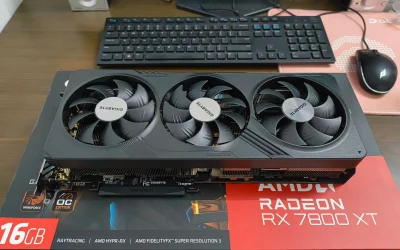

Not every GeForce launch gets the Founders Edition treatment. The Nvidia GeForce RTX 5060 is one of those cards Nvidia leaves entirely to its add-in board partners, so this review is built around the ASUS Dual GeForce RTX 5060 8GB OC Edition, a compact dual-fan card that’s a fair representative of how most people will actually buy this GPU.
Why There’s No Founders Edition Here
Nvidia has consistently skipped Founders Edition cards for its 60-class GPUs in the RTX 50-series lineup. That means every RTX 5060 sold comes from a board partner like ASUS, MSI, Gigabyte, or Zotac, with clock speeds, cooler design, and physical size varying by model. The core GPU silicon and memory configuration stay identical across cards, which is what this review focuses on, with the ASUS Dual used as the physical reference point.
Key Specs
| Spec | Details |
|---|---|
| Architecture | Blackwell, 5nm-class process |
| CUDA cores | 3,840 |
| Boost clock | Up to 2.49 GHz (varies by board partner) |
| Memory | 8GB GDDR7, 128-bit bus, 448 GB/s bandwidth |
| TDP | 145W |
| Power connector | 1x 8-pin PCIe |
| Reference model tested | ASUS Dual RTX 5060 OC, 228 x 123 x 50mm, 2.5-slot |
| Cooler | Dual Axial-tech fans with 0dB idle mode |
Blackwell at the Entry Level
The RTX 5060 carries the same Blackwell architecture as the rest of the RTX 50-series, just with a heavily trimmed core count. That still brings 4th-gen RT cores and 5th-gen Tensor cores down to this price tier, along with:
- DLSS 4 support, including Multi Frame Generation on supported titles
- GDDR7 memory instead of the GDDR6 used on the outgoing RTX 4060
- PCIe 5.0 x8 interface, which can bottleneck on older PCIe 3.0 motherboards
The move to GDDR7 is the more meaningful upgrade here. Even with a relatively narrow 128-bit bus, bandwidth lands at 448 GB/s, a solid jump over the previous generation’s GDDR6 setup.
Cooler and Card Size
The ASUS Dual model used as the reference for this review keeps things compact:
- 228 x 123 x 50mm footprint, a 2.5-slot design
- Two Axial-tech fans that spin down to zero at idle or light load
- Single 8-pin power connector, easy to run on modest power supplies
Cards this size fit into small-form-factor builds without much trouble, which is a big part of the appeal at this tier. Other partner models from Gigabyte and MSI run slightly longer with triple-slot coolers, so it’s worth checking exact dimensions against a case before buying.
Gaming Performance by Resolution
The RTX 5060 is unambiguously a 1080p card, and independent testing backs that positioning up clearly.
- 1080p: Comfortably handles high or maxed settings in most current titles, the GPU’s intended home
- 1440p: Playable in many games at medium to high settings, but the 8GB frame buffer starts to show limits in newer, texture-heavy titles
- 4K: Not a realistic target even with upscaling assistance, both compute and VRAM run out of headroom
Buyers building specifically for 1080p esports or single-player gaming at that resolution are the right audience here.
Ray Tracing and DLSS 4
Ray tracing performance is modest given the entry-level core count, and heavier ray-traced titles need DLSS upscaling to stay smooth even at 1080p. That’s where DLSS 4 and Multi Frame Generation genuinely help, generating additional frames to boost perceived smoothness. Reviewers are generally positive about the feature set here, though it’s worth remembering the underlying raw hardware is still limited for demanding RT workloads.
Power Draw and Efficiency
At a 145W TDP, the RTX 5060 is easy on power supplies, running comfortably on a single 8-pin connector. Real-world draw under gaming load sits close to that rated figure. Compared to the outgoing RTX 4060’s 115W TDP, this generation pulls a bit more power for its performance gains, though efficiency per frame still improved thanks to the process and architecture refinements.
Thermal and Noise Behavior
The ASUS Dual’s dual-fan cooler with 0dB idle mode keeps the card silent during desktop use and light workloads. Under sustained gaming load, temperatures stay in a reasonable range for this power class, and fan noise is generally rated as unobtrusive by reviewers, a common trait for cards in this wattage bracket since there’s simply less heat to dissipate.
Value Against the RTX 4060 and Competition
Pricing for RTX 5060 cards generally lands in the $300-$330 range depending on the partner model chosen. Against the previous-generation RTX 4060, the raw performance gain is modest, in the same single-digit-to-low-double-digit percentage range typical of this generation’s refresh. The bigger practical upgrade is the GDDR7 memory bandwidth and DLSS 4 feature set rather than raw core throughput. AMD’s Radeon RX competitors at a similar price point remain worth cross-shopping for buyers who don’t specifically need DLSS or ray tracing.
Pros and Cons
What stands out
- Compact, efficient cards from nearly every board partner, easy to fit in small builds
- GDDR7 memory bandwidth is a genuine step up over the previous generation
- Low 145W TDP means simple power supply requirements
What gives pause
- 8GB VRAM is limiting in newer titles at anything above 1080p
- No Founders Edition means performance and price vary by board partner
- Raw generational gain over the RTX 4060 is modest
- There’s no Nvidia GeForce RTX 5060 Founders Edition, every card comes from a board partner like ASUS, MSI, or Gigabyte.
- This review uses the ASUS Dual RTX 5060 8GB OC Edition as its physical reference point.
- GDDR7 memory and DLSS 4 are the real upgrades this generation, not raw core performance.
- It’s a 1080p-first GPU, and the 8GB VRAM buffer is the main long-term limitation to weigh.
FAQ
1. Does the RTX 5060 come in a Founders Edition?
No. Nvidia only makes Founders Edition cards for the RTX 5070, 5070 Ti, 5080, and 5090. The RTX 5060 is sold exclusively through board partners.
2. Is 8GB of VRAM enough for the RTX 5060?
For 1080p gaming, generally yes. At 1440p or in VRAM-heavy titles with textures maxed out, 8GB can become a limiting factor.
3. What resolution is the RTX 5060 built for?
1080p. It can run some 1440p titles at reduced settings, but 4K isn’t a realistic target for this tier.
4. How does it compare to the RTX 4060?
Raw performance gains are modest, the bigger upgrades are GDDR7 memory bandwidth and DLSS 4 support.
As a 1080p workhorse, the RTX 5060 does its job well as long as buyers go in with realistic expectations about the VRAM ceiling. The ASUS Dual reviewed here is a solid, unremarkable representative of a GPU that lives or dies on board partner execution rather than any single reference design.
This review is based on independent testing and reporting as of publish date.