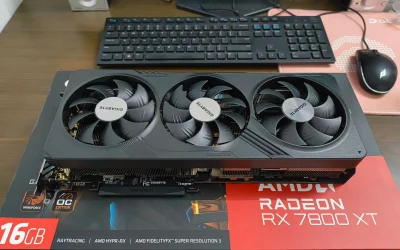

AMD’s RDNA 4 launch made more noise around the RX 9070 XT, but the standard AMD Radeon RX 9070 is the quieter story worth paying attention to, a card built to compete directly in the crowded $500-$600 bracket. This review uses the Sapphire Pulse Radeon RX 9070 as its reference model.
Key Specs
| Spec | Details |
|---|---|
| Architecture | RDNA 4 (Navi 48), 4nm process |
| Stream processors | 3,584 (56 Compute Units) |
| Ray accelerators | 56 |
| Game / Boost clock | 2,070 MHz / 2,540 MHz |
| Memory | 16GB GDDR6, 256-bit bus, 640 GB/s bandwidth |
| TDP | 220W |
| Infinity Cache | 64MB (3rd gen) |
| Reference model tested | Sapphire Pulse RX 9070, triple-fan design |
RDNA 4: AMD’s Ray Tracing Catch-Up Generation
RDNA 4 is the architecture AMD built specifically to close the ray tracing and upscaling gap against Nvidia, and the RX 9070 is where that effort shows up at a mainstream price point. Key changes over RDNA 3 include:
- Significantly improved ray accelerators per compute unit, aimed at closing the RT performance gap with Nvidia
- FSR 4, AMD’s machine-learning-based upscaler, a meaningful step up from the FSR 3.1 algorithm used on RDNA 3 cards
- Refined media engine with better AV1 encode support for streaming and content creation
The RX 9070 doesn’t carry the highest core count in the RDNA 4 lineup, that’s reserved for the RX 9070 XT, but it inherits the same architectural improvements at a lower price.
Cooler and Physical Design
The Sapphire Pulse used as this review’s reference card ships with:
- A triple-fan AeroCurve cooler shared with the higher-tier RX 9070 XT Pulse
- Five 6mm heatpipes running through dual aluminum fin stacks
- A roughly 3-slot design, larger than the card’s 220W TDP strictly requires, which pays off in acoustic terms
That’s a generously sized cooler for the power budget involved, a common approach among partner cards at this tier since it keeps both temperatures and noise well controlled.
Gaming Performance by Resolution
AMD positions the RX 9070 as a strong 1440p card with reasonable 4K capability, and independent testing generally supports that framing.
- 1080p: Overkill for most current titles, plenty of headroom for high refresh rate gaming
- 1440p: The card’s clear sweet spot, handling maxed settings comfortably in the large majority of titles
- 4K: Achievable in many games, particularly with FSR 4 upscaling assistance, though the RX 9070 XT and Nvidia’s RTX 5070 Ti tier pull further ahead here
In raw rasterized performance, the RX 9070 generally trades blows with Nvidia’s RTX 5070 depending on the title, a genuinely competitive position for AMD at this price bracket.
Ray Tracing and FSR 4
Ray tracing has historically been AMD’s weak point against Nvidia, and RDNA 4 narrows that gap noticeably without fully closing it. The RX 9070 handles moderate ray tracing workloads well, though the heaviest path-traced titles still favor Nvidia’s RT core throughput. FSR 4’s shift to a machine-learning upscaling model is the bigger story, bringing image quality much closer to DLSS than any previous FSR version managed, a genuine improvement worth factoring into any comparison against Nvidia’s competing cards.
Power Draw and Efficiency
At a 220W TDP, the RX 9070 sits comfortably below Nvidia’s RTX 5070 Ti and well under the RX 9070 XT’s 304W rating. Real-world measured draw under gaming load tracks close to that figure. That efficiency, combined with the Pulse’s oversized cooler, results in one of the more power-conscious options in its performance class.
Thermal and Noise Behavior
The Sapphire Pulse’s triple-fan cooler, borrowed from the more power-hungry RX 9070 XT variant, keeps this card running cool with plenty of thermal margin. Independent testing found fan noise under load to be modest, benefiting from the cooler being noticeably larger than what a 220W card strictly needs.
Value Against the RTX 5070 and RX 9070 XT
- Pricing generally lands in the $500-$570 range depending on board partner and cooler tier
- Against Nvidia’s RTX 5070, the RX 9070 offers more VRAM at 16GB versus 12GB, a genuine advantage for texture-heavy titles
- Stepping up to the RX 9070 XT costs more but delivers a meaningfully larger performance jump than the price gap alone suggests
For buyers deciding between AMD and Nvidia at this price point, the choice increasingly comes down to whether DLSS 4’s more mature ecosystem outweighs the RX 9070’s extra VRAM headroom and generally competitive pricing.
Pros and Cons
What stands out
- 16GB of VRAM at a price point where Nvidia often offers less
- FSR 4 is a genuine leap in upscaling quality over previous FSR versions
- Strong 1440p performance with reasonable 220W power draw
What gives pause
- Ray tracing still trails Nvidia’s equivalent tier in the heaviest workloads
- FSR 4 game support, while growing, isn’t as broad as DLSS yet
- No AMD reference “Founders Edition” equivalent, pricing and cooler quality vary by partner
- The RX 9070 uses AMD’s RDNA 4 architecture, bringing a major ray tracing and FSR 4 upscaling upgrade over RDNA 3.
- This review is based on the Sapphire Pulse Radeon RX 9070, a triple-fan card built for quiet, cool operation.
- It’s a strong 1440p performer with 16GB of VRAM, generally trading blows with Nvidia’s RTX 5070.
- Pricing typically falls in the $500-$570 range depending on the board partner chosen.
FAQ
1. How does the RX 9070 compare to the RTX 5070?
Raw rasterized performance is generally competitive, trading wins depending on the title. The RX 9070 offers more VRAM, while the RTX 5070 has the more mature DLSS ecosystem.
2. What is FSR 4 and is it a big improvement?
FSR 4 is AMD’s new machine-learning-based upscaler, replacing the older algorithmic approach in FSR 3.1. It’s a meaningful image quality improvement, though it still has a smaller supported game library than DLSS.
3. Is the RX 9070 good for 1440p gaming?
Yes, it’s widely considered the card’s sweet spot, comfortably handling maxed settings in most current titles.
4. How much power does the RX 9070 need?
A 220W TDP, notably lower than the RX 9070 XT’s 304W rating, making power supply requirements relatively modest.
The RX 9070 lands as one of AMD’s more convincing mainstream GPUs in recent memory, closing much of the ray tracing and upscaling gap that’s defined the last few generations against Nvidia. For 1440p gamers who value VRAM headroom, it’s a genuinely strong option.
This review is based on independent testing and reporting as of publish date.