

Modern games continually demand more video memory, making entry-level 8GB models feel cramped when loading high-resolution textures. Upgrading to the best 12GB VRAM graphics cards gives your system enough breathing room to maintain smooth frame delivery across demanding titles. Before buying, many PC builders wonder does GPU or CPU affect FPS more during everyday gaming.
Recommended by Us
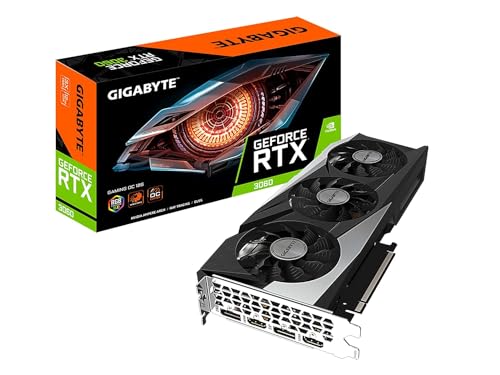
GIGABYTE GeForce RTX 3060 Gaming OC 12G
- Spacious 12GB GDDR6 memory allocation gives plenty of breathing room for high-res assets
- Triple-fan WINDFORCE cooling solution covers the length of the heatsink
- Dedicated second-gen RT Cores and third-gen Tensor Cores enable modern ray tracing features
- Factory-tuned OC profile provides enhanced performance out of the box
- Chassis length of 11.1 inches requires checking clearance in smaller mini-ITX cases
- Specific boost clock speed and TDP wattage figures are not stated in the listing data

MSI GeForce RTX 3060 12GB OC
- Large 12GB GDDR6 VRAM allocation for its class
- Four display outputs including HDMI 2.1 and three DisplayPort 1.4a
- Relatively compact 9.3-inch length easily fits in smaller PC enclosures
- Supports high-resolution outputs up to 7680 x 4320
- Official TDP and recommended power supply wattage are not specified in the listing
- Boost clock frequency is not explicitly detailed in the product specifications

- Generous 12GB GDDR6 VRAM capacity provides longevity for creative workflows
- Space-saving dual-slot design fits effortlessly into compact chassis builds
- Ampere architecture provides dedicated RT and Tensor core capabilities
- Factory-tuned OC profile straight out of the box
- Exact boost clock frequency and power requirements are not listed in the specifications
- Dual-fan cooler offers less heatsink surface area than larger three-fan configurations
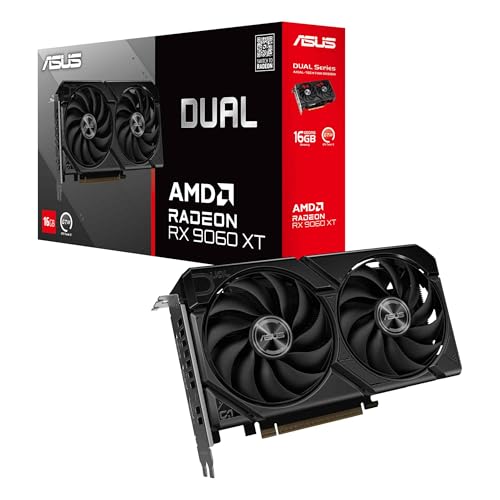
ASUS Dual Radeon RX 9060 XT 16GB
- Generous 16GB GDDR6 memory configuration
- High clock potential reaching up to 3250 MHz in OC mode
- Modern PCIe 5.0, HDMI 2.1b, and DisplayPort 2.1a connectivity
- Hardware Dual BIOS switch for quick acoustic management
- Compact 8-inch length fits easily into smaller PC enclosures
- TDP and power supply wattage recommendations are not stated in the listing
- 2.5-slot thickness can obstruct adjacent PCIe slots on compact motherboards

ASUS Dual GeForce RTX 5060 Ti 16GB OC
- Generous 16GB of next-generation GDDR7 memory buffer
- Compact 9-inch dual-fan design fits small and mid-tower cases
- Dual BIOS switch allows quick acoustic profile selection
- Long-lasting dual ball bearing fans with 0dB silent mode
- Listing does not state rated TDP or minimum power supply requirements
- 2.5-slot thickness can block adjacent motherboard expansion slots

- Generous 10GB GDDR6 VRAM offers more capacity than standard 8GB entry-level options
- Cutting-edge display output support with three DisplayPort 2.1 connections
- Built-in AV1 video encoding support tailored for streamers and video editors
- Rigid metal backplate protects components and prevents board flexing
- Thermal design power (TDP) rating is not listed in the technical data
- PCIe interface revision and lane configuration are not specified

MSI RTX 3060 Ventus 2X 12G OC
- Generous 12GB GDDR6 video memory allocation
- Compact Torx twin fan layout fits easily into most standard cases
- Extensive multi-monitor connectivity with four display outputs
- Supports high-resolution output up to 8K (7680 x 4320)
- TDP and power supply requirements are omitted from the listing specifications
- Dual-fan design offers less heatsink surface area than larger three-fan variants
Choosing the Right Card for Your Build
If you have plenty of chassis space and want maximum cooling surface area, I would go with the Gigabyte RTX 3060 Gaming OC. Its three Windforce fans spread heat across a large fin stack, and its generous 12GB frame buffer on a 192-bit bus handles dense textures with zero drama. The underlying Ampere architecture from NVIDIA provides second-generation RT cores and third-generation Tensor cores that handle modern visual workloads gracefully.
If you run a more modest mid-tower or compact chassis, the MSI RTX 3060 Ventus 2X is the card I would point toward instead. It keeps the identical 12GB GDDR6 memory setup but runs a dual-fan Torx cooler with a factory boost clock of 1807 MHz. Builders upgrading older systems often check whether does a GPU need to be compatible with your motherboard, and this dual-slot card fits standard PCIe slots with minimal fuss.
Alternatively, budget-minded builders seeking a dual-fan option with solid clock speeds can look at the Gigabyte RTX 3060 Windforce OC, which balances steady thermal dissipation with a trimmed physical footprint.
FAQs
1. Is 12GB of VRAM enough for 1440p gaming?
A 12GB memory capacity is well suited for modern 1440p gameplay. Many newer titles easily consume over 8GB of video memory when rendering ultra textures and ray-traced shadows. Having a 12GB buffer prevents stuttering caused by system memory swapping, keeping your frame pacing consistent across demanding visual settings.
2. What power supply is recommended for a 12GB graphics card?
Most mid-tier 12GB models operate comfortably on a quality 550W to 650W power supply. Cards in this category typically rely on a single 8-pin PCIe power connector and standard board power limits. Checking your power unit ensures clean current delivery without sudden shutdowns during demanding gaming workloads.
3. Does graphic memory capacity degrade over time?
Physical video memory does not lose its storage capacity or slow down simply from age. Many gamers ask does GPU performance degrade over time, and performance drops usually stem from dust accumulation or background software bloat rather than memory wear. Keeping fans clean helps maintain peak factory frequencies indefinitely.
4. Can a 12GB graphics card run high refresh rate monitors?
These graphics cards easily drive high-refresh monitors through integrated DisplayPort 1.4a and HDMI 2.1 connections. Hardware publications like Tom’s Hardware frequently note that having extra video memory helps maintain higher minimum frame rates in competitive shooters. The expanded buffer ensures you hit steady output at 1080p and 1440p.
Editor’s Verdict
For builders who want reliable cooling and ample video memory, the Gigabyte RTX 3060 Gaming OC and compact MSI RTX 3060 Ventus 2X stand out among the best 12GB VRAM graphics cards on the market today. Both cards provide a spacious 12GB frame buffer across a 192-bit memory interface, ensuring smooth texture streaming for modern gaming.


