
Modern PC games demand serious rasterization throughput and hefty video memory buffers, making an outdated video card an immediate bottleneck. When planning an upgrade, understanding whether your GPU or CPU affects FPS more helps pinpoint system priorities. Finding the best AMD graphics cards ensures dependable raster performance across varied desktop resolutions without unnecessary display stutters.
Recommended by Us

ASUS PRIME Radeon RX 9070 XT OC
- Substantial factory boost clock reaching up to 3030 MHz in OC mode
- Efficient 2.5-slot form factor provides solid chassis clearance
- 0dB silent mode allows fans to halt completely during lighter loads
- Hardware Dual BIOS toggle allows driver-free acoustic optimization
- Manufacturer listing does not state the official TDP wattage
- Card length of 12.3 inches requires careful measurement in compact cases
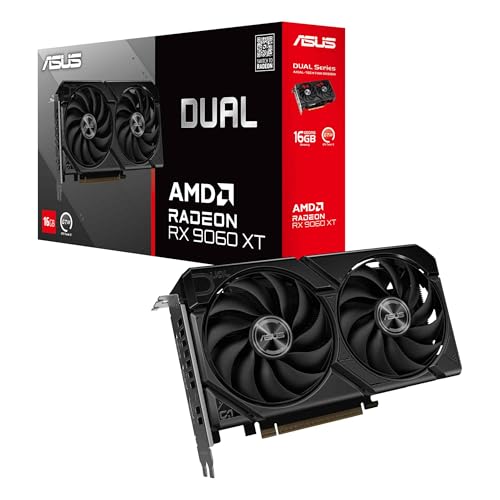
ASUS Dual Radeon RX 9060 XT 16GB
- Generous 16GB GDDR6 memory configuration
- High clock potential reaching up to 3250 MHz in OC mode
- Modern PCIe 5.0, HDMI 2.1b, and DisplayPort 2.1a connectivity
- Hardware Dual BIOS switch for quick acoustic management
- Compact 8-inch length fits easily into smaller PC enclosures
- TDP and power supply wattage recommendations are not stated in the listing
- 2.5-slot thickness can obstruct adjacent PCIe slots on compact motherboards

ASRock RX 9070 Challenger 16GB OC
- Substantial 16GB GDDR6 memory on a wide 256-bit interface
- Factory overclocked boost clock of 2520 MHz out of the box
- Triple-fan cooler featuring 0dB silent fan operation under light loads
- Modern PCIe 5.0 interface support
- Specific board TDP is not detailed in the manufacturer specifications
- Card length of 290mm and 2.5-slot profile requires verification of PC case clearance

ASRock Radeon AI PRO R9700 Creator 32GB
- Substantial 32GB GDDR6 buffer accommodates oversized AI datasets and complex creative scenes
- Blower-style thermal design expels heat externally to keep multi-GPU enclosures cooler
- Compact dual-slot thickness ensures easy stacking in server chassis and workstation motherboards
- Equipped with modern DisplayPort 2.1a ports and PCIe 5.0 interface support
- Blower fan configuration generates more audible noise compared to open-air triple-fan coolers
- Specific TDP and power supply connector requirements are not stated in the official specifications
- Tailored for workstations, requiring verification of software and enterprise driver compatibility

ASRock RX 9070 XT Steel Legend 16GB
- Fast 2970 MHz factory boost clock offers immediate performance gains
- Generous 16GB VRAM pool running at 20 Gbps for high-resolution assets
- Features cutting-edge PCIe 5.0 and DisplayPort 2.1a hardware standards
- Reinforced metal frame helps prevent long-term graphics card sag
- Bulky 2.9-slot profile demands significant physical clearance inside the chassis
- Exact thermal design power is not detailed in the official listing
- High 800W recommended power supply requirement

Maxsun AMD Radeon RX 550 4GB ITX
- Compact form factor ideal for small-form-factor and ITX computer builds
- Multiple video outputs (DisplayPort, HDMI, DVI-D) accommodate older and newer monitors
- Dedicated 4GB VRAM handles light editing, CAD/CAM work, and general media playback
- Solid capacitor and silver-plated PCB design helps sustain hardware durability
- Official TDP and power consumption figures are not specified in the listing
- Entry-level performance intended for light gaming rather than demanding modern titles

ASRock RX 7600 Challenger Pro OC
- Oversized triple-fan thermal assembly delivers superior heat dissipation compared to compact designs
- High factory boost clock of 2695 MHz provides strong out-of-the-box speeds
- Protective metal backplate adds structural rigidity and prevents PCB sagging
- 0dB silent mode guarantees noise-free operation while browsing or idling
- Long 303 mm card length demands considerable clearance in smaller PC cases
- Utilizes a PCIe 4.0 x8 link rather than a full x16 lane configuration
- Exact board TDP wattage is not clearly detailed in the product specifications
Matching the Right Radeon Card to Your Setup
Every gaming rig has distinct thermal constraints and performance goals, so balancing card dimensions with power requirements matters just as much as raw speed. As detailed by AMD, newer architectures focus heavily on memory efficiency and unified computing units. Before committing to a specific model, verify whether a GPU needs to be compatible with your motherboard and PC chassis to avoid physical spacing surprises.
- If you aim for high-resolution 4K action with room for heavy texture packs, I would go with the ASRock RX 9070 XT Steel Legend because of its 16GB GDDR6 memory on a 256-bit bus, high 2970 MHz boost clock, and triple-fan thermal layout that demands an 800W power supply.
- For balanced 1440p gaming in mid-tower cases, I would point builders toward the ASUS Dual RX 9060 XT, which packs 16GB GDDR6 VRAM, a 3250 MHz boost clock in OC mode, and a compact 2.5-slot profile with dual BIOS flexibility.
- Budget-conscious players targeting high refresh rate 1080p should look at the ASRock RX 7600 Challenger Pro, featuring 8GB of GDDR6 memory, a 2695 MHz boost clock, and modest 550W power supply needs.
FAQs
Q: How much VRAM is necessary for modern PC gaming?
A: For standard 1080p gaming, 8GB of video memory handles modern titles well. Stepping up to 1440p or 4K resolutions requires 16GB of VRAM to maintain high-resolution textures and avoid memory swapping. Hardware analysis sites like TechPowerUp regularly outline how uncompressed game assets demand broader memory buses.
Q: Does graphics card silicon lose speed as it ages?
A: Many builders wonder if GPU performance degrades over time due to wear. The silicon core itself does not slow down, but dried thermal paste and clogged fan heatsinks can lead to thermal throttling. Regular dust maintenance keeps your clock frequencies operating at their factory specifications.
Q: What power supply wattage do high-end Radeon cards require?
A: Power needs depend entirely on the specific card tier and board design. A mid-tier option like an RX 7600 runs reliably on a 550W power supply with a single 8-pin connector. Demanding models such as the RX 9070 XT require two 8-pin PCIe connectors and an 800W unit to handle transient load spikes safely.
Q: How do custom Radeon desktop cards compare to console hardware?
A: Dedicated desktop cards offer significantly higher clock speeds and configurable cooling setups than unified console chips. Readers researching what GPU the PS5 has will find that modern discrete Radeon models deliver substantially higher memory bandwidth and independent thermal headroom for demanding desktop software.
Editor’s Verdict
For dedicated PC builders seeking the best AMD graphics cards, the ASRock RX 9070 XT Steel Legend delivers outstanding 4K rasterization and massive memory headroom. If your desktop build prioritizes balanced 1440p value, the ASUS Dual RX 9060 XT remains a stellar performer.