
A quiet build needs more than padded panels. Cooling layout, fan quality, and unrestricted airflow all affect how hard the system must work. The best quiet PC cases balance sound control with practical thermals, while our overview of PC cases for airflow explains the cooling side in more detail.
Recommended by Us
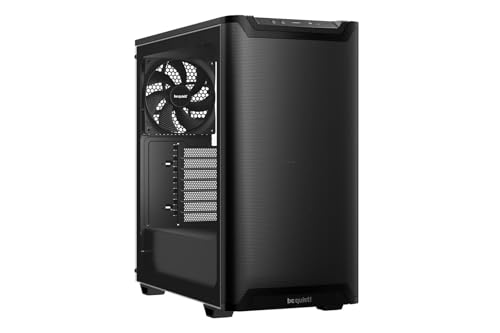
be quiet! Pure Base 501 Airflow ATX Case
- Strong fan and radiator mounting flexibility for its compact format
- Included 140mm PWM fan is designed to reduce turbulence and noise
- Supports conventional or vertical graphics card installation
- Modern front connectivity includes USB Type-C and two Type-A ports
- Clean, understated styling suits builds without excessive visual decoration
- Vertical GPU installation requires an optional riser cable
- Exact maximum GPU clearance is not provided in the listing
- Front-panel material and construction are not specified
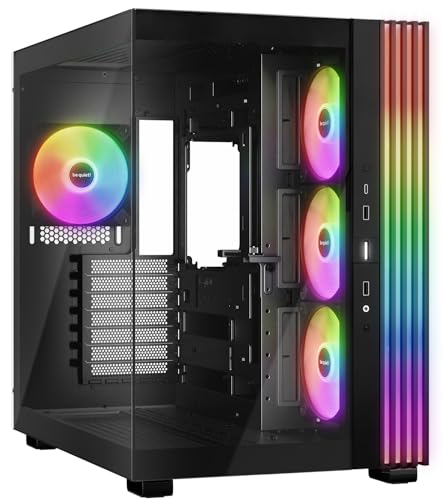
be quiet! Light Base 600 LX Black
- Highly flexible case orientation
- Extensive fan and radiator capacity
- Front and side windows provide wide component visibility
- Dual-chamber design helps separate cables and drives
- Integrated ARGB and PWM hubs simplify device connections
- No fans are pre-installed
- Exact maximum GPU length is not listed
- Provided feature text refers to the DX White version despite the product title identifying the LX Black model

be quiet! Silent Base 802 Black ATX Case
- Choice of airflow-focused or silence-focused panel configurations
- Three fans are included
- Room for radiators up to 420mm
- Flexible inverted-layout capability
- Modern front I/O with Type-C connectivity and fan control
- Maximum graphics card length is not specified in the listing
- Supported fan sizes and total mounting capacity are not detailed
- At approximately 27.8 pounds, the empty case is relatively heavy

be quiet! Light Base 500 Windowed ATX Case
- Includes four PWM fans from the factory
- Generous 400mm graphics card clearance
- Supports Asus BTF, MSI Project Zero, and Gigabyte Project Stealth designs
- Removable side fan frame should make fan installation more accessible
- Can hold two HDDs and two SSDs simultaneously
- No integrated LED lighting for builders who prefer illuminated cases
- Fully windowed front relies on the side intake rather than direct front airflow
- Panel material is not specified in the provided listing

be quiet! Light Base 600 DX White Case
- Flexible orientation adapts to different desk and room layouts
- Extensive fan and radiator installation options
- Showcase-focused windowed design with integrated ARGB lighting
- Dual-chamber interior helps separate cables and drives
- Top and bottom hubs simplify ARGB and PWM connectivity
- No fans are pre-installed
- Exact maximum GPU length is not provided in the listing
- Windowed front prioritizes component visibility rather than a stated mesh intake

be quiet! Pure Base 501 Airflow White
- Strong fan and radiator flexibility for a compact ATX case
- Includes a 140mm PWM fan
- Supports conventional or vertical GPU installation
- Modern front connectivity includes USB-C and two USB-A ports
- Minimalist white design suits understated gaming and workstation builds
- Vertical GPU mounting requires an optional riser cable
- Maximum graphics card length is not specified in the listing
- Front panel material and construction are not detailed

be quiet! Dark Base Pro 701 White ATX
- Airflow-focused open mesh design
- Three premium 140mm PWM fans are included
- Flexible integrated fan and ARGB connectivity
- Tempered-glass window complements illuminated builds
- Fan controller can connect to a motherboard PWM header
- Maximum GPU clearance is not provided in the listing
- Radiator compatibility is not specified
- The 28.2-pound chassis may be cumbersome to move
Choosing the Right Balance of Silence and Cooling
I would choose according to whether you prioritize insulation, compact dimensions, or cooling headroom. A case that moves air efficiently can let its fans run more gently, while insulated panels help contain mechanical and fan noise. Builders planning a large liquid-cooling setup should also compare these options with our PC cases for water cooling. Tom’s Hardware also covers case cooling and component selection in depth.
- If low-noise construction is your main concern, the be quiet! Silent Base 802 is the one I would choose. Its extra-thick insulation mats target noise reduction, while interchangeable front and top panels let you switch between quieter operation and stronger airflow as your hardware demands change.
- For a simpler, more compact build, I would point most buyers toward the be quiet! Pure Base 501 Airflow. It includes a 140mm PWM fan designed to reduce turbulence and supports substantial front and top cooling, giving builders room to tune fan speeds without choosing an oversized enclosure.
- For powerful hardware that needs generous ventilation, I would go with the be quiet! Dark Base Pro 701. Its open mesh layout and three included 140mm Silent Wings 4 PWM fans make it a strong fit for buyers who want quiet-oriented fans without restricting intake airflow.
FAQs
1. What makes a PC case quiet?
Quiet cases usually combine controlled airflow, low-vibration mounting, quality fans, and sometimes sound-dampening material. Good ventilation also matters because restricted airflow can force fans to spin faster. The goal is not simply to block sound, but to prevent unnecessary noise from being created in the first place.
2. Is an airflow case or an insulated case quieter?
Either design can work well, depending on the components and fan settings. Insulated panels can contain noise, but mesh panels may help fans run at lower speeds by providing less restrictive airflow. For high-power hardware, efficient ventilation often offers a better overall balance than sealing the system behind solid panels.
3. How many case fans are needed for a quiet PC?
There is no universal number because heat output, fan size, cooler choice, and case layout all matter. Several well-positioned fans running gently can sound more agreeable than fewer fans working hard. Start with balanced front intake and rear exhaust, then adjust fan curves based on your system’s cooling needs.
4. Does PC case size affect noise?
Case size can influence component clearance, airflow paths, and the space available for larger fans or radiators. A larger enclosure is not automatically quieter, and a compact model is not automatically loud. Our explanation of PC case sizes by category can help you match the enclosure to your motherboard and hardware.
5. Can a glass PC case still run quietly?
Yes, although the ventilation design matters more than the window itself. A glass-sided case with adequate intake openings and well-managed fans can remain reasonably quiet. Large glass front panels may restrict direct airflow, so check the side, bottom, and top intake options before choosing a display-focused enclosure.
Editor’s Verdict
Among the best quiet PC cases, the be quiet! Silent Base 802 is my first choice for buyers who value insulation and configurable panels. I would choose the be quiet! Pure Base 501 Airflow instead for a cleaner, more compact build that combines quiet-oriented design with flexible cooling support.