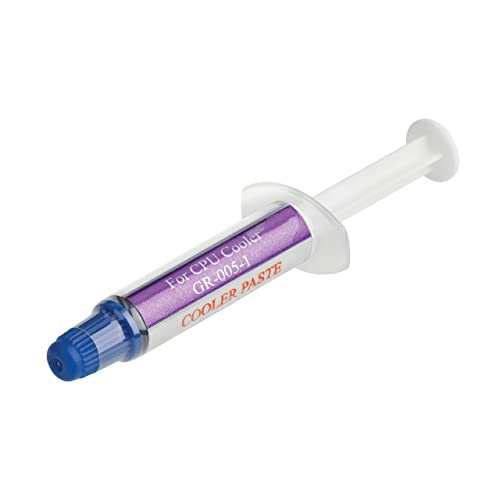

Long gaming sessions and demanding workloads repeatedly heat and cool your hardware, which can gradually push ordinary compound away from the contact area. The Best Thermal Pastes Without Pump-Out help maintain an even bond between the chip and cooler for steadier long-term cooling.
Recommended by Us

- Listed as non-conductive
- States 9.8W/Mk thermal conductivity
- Non-drying, easy-application claims
- Broad stated compatibility across computers and consoles
- Compact 2g amount for smaller maintenance jobs
- Technical details table is not provided in the listing data
- 2g may be limiting for users servicing multiple large systems
- The listing does not specify the compound's material composition or included application tools

- 4 g size offers a compact amount for individual projects
- Product title emphasizes ultimate performance
- Long durability is a stated product focus
- Made by ARCTIC, a dedicated cooling-component brand
- Thermal conductivity is not specified in the provided listing
- Electrical conductivity is not specified in the provided listing
- Material formulation details are not listed

- Compact 2 g quantity is practical for smaller paste needs
- Listing emphasizes performance-focused use
- Long durability is highlighted in the product title
- Suitable category for CPU and GPU cooling maintenance
- No thermal-conductivity rating is provided in the available data
- Electrical-conductivity information is not listed
- Paste composition and application details are not specified

ARCTIC MX-7 4 g with MX-Cleaner
- MX-Cleaner is included with the thermal paste
- 4 g package offers a clearly stated quantity
- Suitable category for CPU and GPU thermal interface maintenance
- Simple package configuration with paste and cleaner together
- Thermal conductivity is not specified in the listing
- Electrical conductivity information is not provided
- The listing does not state detailed application or material information

- Pump-out and drying resistance are specifically highlighted
- Broad stated compatibility across CPUs, GPUs, laptops, and consoles
- Nano diamond-ceramic technology is identified in the product title
- 3.5g quantity offers more material than a single tiny application packet
- Thermal conductivity is not specified in the available listing data
- Electrical conductivity is not specified
- No application tool or included accessories are listed
- Non-conductive property is clearly stated
- Thermal conductivity is listed as 9.8W/Mk
- 4g quantity is specified
- Designed for CPU thermal paste use
- The listing does not specify the paste composition
- No application tools, coverage estimate, or curing information is listed
- No temperature performance results are provided

- Generous 8 g amount
- Long durability is advertised
- Clearly identified ARCTIC MX-7 model
- Listed under the Silicon Grease thermal compound category
- Thermal conductivity is not specified in the supplied listing
- Electrical conductivity information is not listed
- Application accessories and detailed composition are not specified
Which Compound Fits Your Hardware
Paste consistency, package size, and application method matter as much as a durability claim. I would choose according to the hardware being serviced and how comfortable you are applying a thicker compound.
- For a desktop CPU or GPU refresh, I would go with ARCTIC MX-7 4g. Its dense, highly viscous formula is designed to resist pump-out, dry-out, and bleeding during repeated thermal cycles, and it is electrically non-conductive. It spreads under cooler pressure rather than by hand, so follow the mounting process carefully.
- I would point frequent builders toward FEHONDA 9.8W/Mk 4g, since the larger amount suits several maintenance jobs. It is listed as non-conductive, applies with a spatula, and uses a low-volatility silicone oil formula intended to limit separation, evaporation, and pump-out. ARCTIC publishes product information on its official site.
- For a laptop, console, or overclocked system, I would consider Gelid GC-5 3.5g. Its polymer composition is made to fill small surface irregularities while resisting drying and pump-out. Use a careful method from this CPU repasting walkthrough when replacing old compound.
FAQs
Q: What causes thermal paste pump-out?
A: Pump-out occurs when repeated expansion and contraction from changing temperatures gradually moves paste away from the center of the chip. A compound with strong cohesion and suitable viscosity can better hold its position. Proper mounting pressure and clean, flat contact surfaces also help preserve the thermal interface.
Q: Can I use pump-out-resistant paste on a GPU?
A: Yes, non-conductive thermal paste is commonly suitable for GPU dies when applied carefully. Before opening a graphics card, check whether a GPU comes with thermal paste and remember that pads around memory and power components may need to remain in their original positions.
Q: Should I spread a high-viscosity thermal paste by hand?
A: Follow the compound maker’s application directions rather than assuming every paste should be manually spread. Some thick formulas are intended to distribute naturally when the cooler is tightened. This approach can reduce trapped air, provided the cooler is lowered straight down and secured evenly.
Q: How often should thermal paste be replaced?
A: Replace paste when servicing a cooler that has been removed, when temperatures have become unexpectedly worse, or when existing compound looks dry or uneven. There is no single calendar interval for every PC. Durable formulas can reduce the need for frequent maintenance under normal use.
Q: Do new CPU coolers include thermal paste?
A: Many coolers arrive with paste pre-applied or included in the box, but not all of them do. Check the package contents before starting a build. This guide on CPU coolers and included thermal paste explains what to expect.
Editor’s Verdict
For most builders, Best Thermal Pastes Without Pump-Out starts with ARCTIC MX-7 4g because its dense, non-conductive formula is specifically designed for long-term stability under thermal cycling. Choose FEHONDA 9.8W/Mk 4g instead if you want an easy-to-spread option with enough compound for repeated maintenance work.