

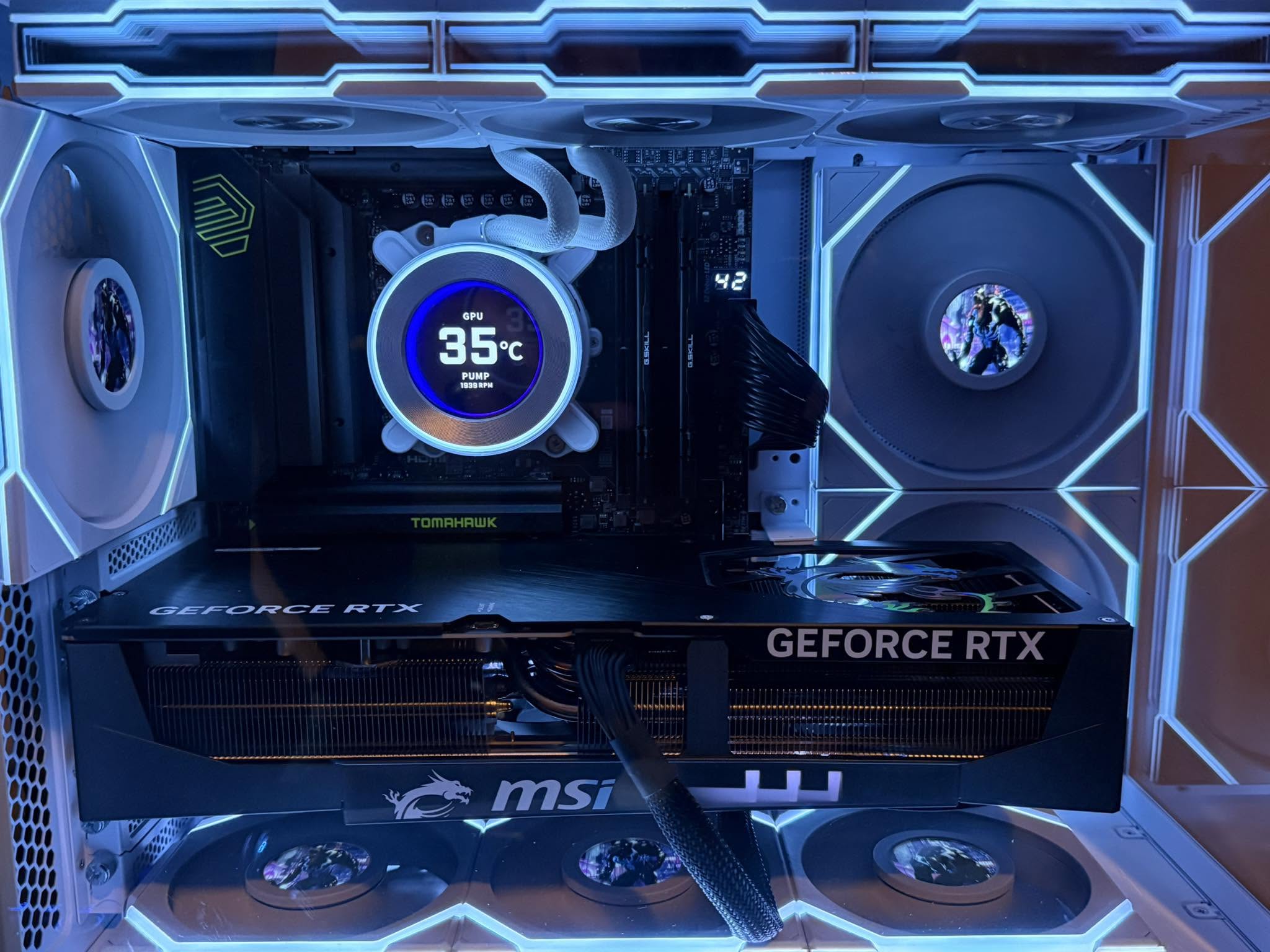
A GPU and a graphics card aren’t technically the same thing, but the difference rarely matters in everyday conversation. The GPU is the processing chip; the graphics card is the complete board built around it, with memory, cooling, and power connectors. You can’t buy the chip separately, so most people use both terms for the same product.
- GPU is the chip. Graphics card is the full board around it.
- Video card is just the older name for the same product.
- The terms are interchangeable in casual use.
- It only matters when you’re talking about laptops or integrated graphics.
What Is a GPU?
A GPU is a processor, like a CPU, but built for a different job (see our full breakdown of how a GPU actually works for more on that). Intel’s own explainer puts it simply: it’s a specialized chip designed to render graphics and handle parallel tasks far faster than a general-purpose CPU can.
A CPU handles general tasks one after another. A GPU does thousands of small calculations at once. That’s exactly what rendering an image needs: millions of pixels, each one calculated separately, all at the same time.
GPUs come in two flavors:
- Integrated GPU (iGPU): built into the same chip as your CPU, sharing its memory and power.
- Discrete GPU (dGPU): a separate chip with its own dedicated memory, mounted on its own board.
When people say they’re “upgrading their GPU,” they almost always mean the discrete kind. Not sure what card is currently in your machine? Here’s how to check what GPU you have.
What Is a Graphics Card?
A graphics card is the physical product you’d actually buy. It’s a circuit board with the GPU chip soldered on, plus everything that chip needs to work on its own:
- VRAM: dedicated video memory, separate from your system’s RAM
- Cooler: fans, a heatsink, or both
- Power connectors: 6-pin, 8-pin, or the newer 12VHPWR
- Display outputs: HDMI, DisplayPort
- PCIe connector: plugs into your motherboard
The GPU chip does the actual work. Everything else on the card exists to keep that chip fed, cooled, and connected. Nvidia’s own product pages for its GeForce line list exactly these specs side by side for each card.
Why bother with a separate card at all? Powerful GPUs run hot, and a proper cooler needs room to breathe. Putting the GPU on its own board also means you can upgrade it independently of your CPU, run more than one in the same PC, and let companies compete on building the best card around the same chip. Curious which companies actually build them? See who makes GPUs and where they’re manufactured.
What Is a Video Card?
Here’s where sources actually disagree a little.
In everyday use: “video card” is just an older name for a graphics card. It was the common phrase through the 1990s, before 3D acceleration became the hardware’s main job. Plenty of people, and retailers, still default to it.
In a stricter technical sense: a “video card” is a specialist product built for video work: capturing, encoding, and decoding footage, the way a Blackmagic capture card or Elgato device does. By that definition, it’s not quite the same product as a graphics card. A graphics card handles rendering and gaming. A dedicated video card handles video pipelines.
In practice, if you walk into a store and ask for a video card, you’ll get a graphics card. Nobody’s handing you a Blackmagic capture device unless you ask for one by name.
So Are GPU and Graphics Card the Same Thing?
Practically, yes. Technically, no. The GPU is one part of the graphics card, not the whole product.
But this rarely trips anyone up. Here’s why: you can’t buy a bare GPU chip on its own.
Compare that to a CPU. You buy the CPU chip separately, then install it into your motherboard’s socket yourself. With graphics hardware, the chip always ships pre-mounted on its card. There’s no everyday scenario where you’d need to talk about the two as separate objects, so the words merged into one meaning over time.
It only works one direction. Calling a graphics card “the GPU” is fine and universally understood. Calling the chip itself “the graphics card” when you specifically mean the silicon is a lot rarer, since most people never need to isolate the chip from the board it’s soldered to.
When the Difference Actually Starts to Matter
This stops being a technicality the moment you shop for a laptop.
Most laptop GPUs are soldered directly onto the motherboard. No separate card exists. That’s why you can’t upgrade a laptop’s graphics the way you’d swap a desktop card, and why laptop spec sheets say “the GPU,” never “the graphics card.” Wondering where a desktop card physically sits? See where the GPU is in a PC.
Same logic applies to integrated graphics. Asking whether a CPU “has a GPU” means asking about the iGPU built into that chip, not a separate card. Calling that a graphics card would just be wrong. There’s no card to point at.
The practical takeaway: when buying a prebuilt PC or laptop, check whether it lists a dedicated GPU or just an integrated GPU. Microsoft’s own guide on checking your GPU walks through exactly where to find this in Windows. That one spec tells you almost everything about gaming performance and upgrade potential. Once you’ve got a discrete GPU, it’s also worth knowing what temperature range is normal for it.
On the CPU side: whether a CPU is the same as a processor.
Frequently Asked Questions
Is GPU the same as graphics card?
Not exactly, but they’re used interchangeably in practice. The GPU is the processing chip; the graphics card is the full board built around it.
Is a video card the same as a graphics card?
Usually, yes, it’s just an older name for the same product. Some technical sources reserve “video card” for specialist video capture and encoding hardware, but in stores and casual conversation, the terms are treated as identical.
What’s the difference between a graphics card and a graphics driver?
A graphics card is physical hardware. A graphics driver is software that lets your operating system talk to that hardware. You update the driver; you swap the card. They’re not interchangeable terms, unlike GPU and graphics card.
Does every computer have a GPU?
Yes. Every computer needs a GPU to output anything to a screen. Not every computer has a separate graphics card though; many laptops and budget desktops rely on integrated graphics instead.
Can you buy just a GPU chip without the card?
No, not as a regular consumer. GPU chips ship pre-mounted on graphics cards from the manufacturer. There’s no retail channel for buying a bare chip the way there is for CPUs.
Is graphics card the same as VRAM?
No. VRAM is just one component on the card. The graphics card needs both the GPU to process graphics and VRAM to store the data it’s working with.
