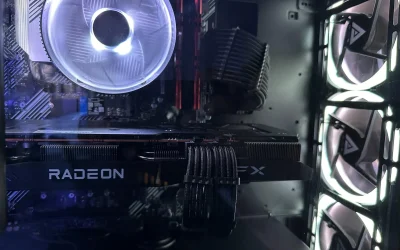

For most games, the GPU matters more, because it renders the visuals and sets your resolution and detail ceiling. The CPU still matters for high frame rates at 1080p, physics, and AI, and a weak CPU can bottleneck a strong GPU. The best gaming PC is balanced, with the GPU getting the larger share of your budget.
- The GPU has the biggest effect on visuals, resolution, and FPS in most games.
- The CPU matters most for high-refresh 1080p and CPU-heavy games.
- Your monitor decides which one does more of the work.
- A mismatched pair causes stutter or wasted money.
What the GPU Does in a Game
The GPU renders everything you see: textures, shadows, lighting, reflections, and ray tracing. That’s why it’s usually the first thing to upgrade when a game looks or runs poorly. If you’re curious how it pulls that off, see how a GPU actually works.
What the CPU Does in a Game
The CPU sends the GPU instructions about what to draw each frame. It also runs the game’s logic, physics, AI, and player input. Both are needed, and Corsair’s breakdown makes the same point: the GPU handles the heavy visual work, but it can’t do the job alone.
Which One Matters More Depends on What You Play
| What you’re doing | Which matters more |
|---|---|
| 4K, ultra settings, ray tracing | GPU |
| 1080p at 144Hz to 240Hz | CPU |
| Competitive shooters like Valorant or CS2 | CPU |
| Flight simulators and open-world RPGs with lots of NPCs | CPU |
| Graphics showcases like Cyberpunk 2077 | GPU |
The reason is your monitor. At 1080p and a very high refresh rate, the PC has to produce a huge number of frames, and the CPU has to prepare every one. On a 4K monitor at high detail, each frame is far heavier to draw, so the GPU does most of the work.
Rule of thumb: if your GPU sits near 100% while gaming, it’s the limiting factor, which is normal for a well-balanced build. If the GPU sits well below that and your FPS is low, look at the CPU. Whether 100% GPU usage is a problem depends on the situation.
What Happens When They Don’t Match
Every PC has a limiting part, so the goal is to avoid an obvious mismatch. A powerful GPU with an entry-level CPU can look great on high settings, but may stutter or drop frames in CPU-heavy games. A strong CPU with a mainstream GPU tends to give lower input lag and higher FPS, but caps your resolution and settings.
Before you upgrade anything, find out exactly what GPU you have, and check whether it’s the part in question. Nvidia and AMD both list recommended systems on their product pages, like Nvidia’s GeForce range and AMD’s support pages.
Related reading: a GPU bottleneck how to upgrade a GPU.
On the CPU side: a CPU bottleneck how to upgrade a CPU.
Frequently Asked Questions
Does the GPU affect FPS?
Yes, more than any other single part in most games. A faster GPU raises FPS when the game is limited by graphics, especially at high resolutions and detail levels.
Is it better to spend more on the CPU or the GPU?
Usually the GPU. For the same total budget, a mid-range CPU with a strong GPU gives more FPS in most games than a top CPU with a weak GPU.
When does the CPU matter more than the GPU?
At high refresh rates (144Hz or more) at 1080p, and in games heavy on physics, AI, or simulation such as competitive shooters and flight simulators.
What is a CPU bottleneck?
It’s when the CPU can’t prepare frames fast enough to keep the GPU busy, so the GPU sits partly idle and your FPS is lower than the card is capable of.